
Guide · 2 September 2026 · 4 min read
Thermally Broken or Not? Choosing Walk-On Glass for Indoors and Outdoors
Walk-on roof lights come in a non-thermal 33 mm laminated build for internal glass floors and a thermally broken build with an argon cavity for external roofs. Here is how to choose, and what you gain by getting it right.
Every walk-on roof light we make is built around the same structural core: multiple toughened panes laminated into a single load-bearing sheet that is rated for foot traffic. Where the two builds diverge is what sits underneath that sheet. The non-thermal build stops at the laminated glass; the thermally broken build adds a sealed, argon-filled cavity and a further pane to turn the unit into an insulated glazing unit. Choosing between them is mostly a matter of answering one question — where is the glass going?
Internal: the non-thermal build
A glass floor in a landing, a bridge across a double-height hall, a walkway over a lower-ground kitchen, a window in the floor that lets light drop from one storey to the next — these are internal applications where both sides of the glass are in the same heated envelope. There is no temperature difference to insulate against, so an insulating cavity adds cost and depth for no benefit.
The non-thermal unit is around 33 mm thick, built from toughened panes laminated together. It offers the same certified walk-on strength as the thermal build, excellent clarity and a slimmer profile that is easier to detail flush with a finished floor. It is also the cheapest way to buy walk-on glass, which is why we flag it as the value choice for indoor use.
External: the thermally broken build
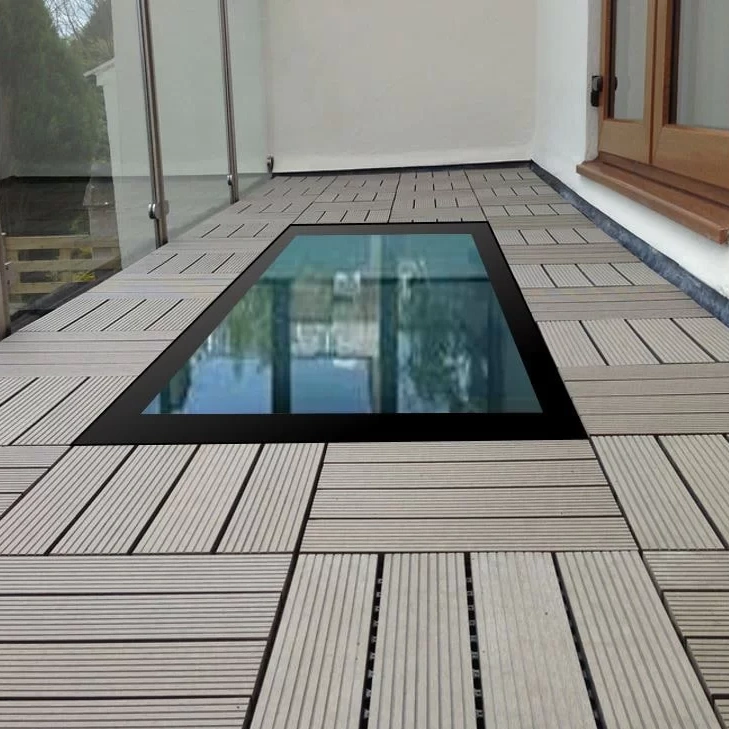
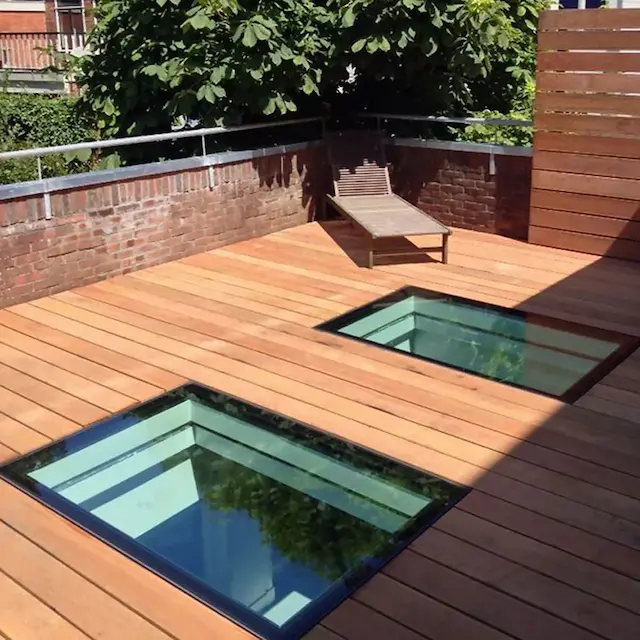
A roof terrace over a bedroom, a balcony floor above a living room, a flat-roof panel bringing daylight into a basement — here one face of the glass is outside and the other is looking up from a heated room. Without insulation, a single laminated sheet does two unwelcome things: it leaks heat all winter, and its cold underside becomes a surface where warm indoor air condenses.
The thermally broken walk-on unit answers both problems. Beneath the structural walk-on glass sits an argon-filled cavity and an additional pane, sealed as an insulated unit. The cavity is the thermal break: it interrupts the heat path, so the inner surface stays closer to room temperature, condensation risk drops sharply and the room below is noticeably more comfortable. It is the build we recommend for any external application over occupied space, and the one that keeps you on the right side of Part L for the glazed area — see our guide to roof light U-values and Part L.
What actually changes between the two
It helps to be precise about what the thermal option is and is not. It is not thicker walk-on glass — the load-bearing laminate is the same. It is an extra pane and a cavity, which means:
- The unit is deeper. Allow for that in the upstand height and any flush-threshold detail with a terrace deck or paving.
- The unit is heavier. Two people should handle small panels; larger units need lifting equipment and a properly designed support.
- The unit is an insulated glazing unit, so its edge seal must stay dry and shaded, which the perimeter seal and bearing detail are designed to achieve.
Everything else — frameless or framed, clear, opaque or anti-slip, made to measure up to 1320 × 2820 mm — is available in both builds.
Frameless thermal: no frame fee
One detail buyers often miss: a thermally broken frameless walk-on unit carries no separate frame fee. The thermal glass rate covers the build, and the unit sits directly on the prepared upstand. If you want the insulated build and the flush, edge-to-edge look, that combination is usually the most cost-effective way to get it. A framed thermal unit adds a fixed frame charge for the perimeter frame and its fixing detail.
Grey areas: garages, porches, unheated stores
Not every external roof is over a living room. A walk-on panel in a flat roof above an unheated garage or a detached store has nothing warm underneath to protect, and a non-thermal unit can be perfectly reasonable. The test is simple: if the space below is heated or someone will be spending time in it, specify thermal. If it is unheated and unoccupied, non-thermal is often enough. If you are unsure which side of the line a space falls, tell us what is below the glass and we will advise.
Ordering the right build
The configurator asks for the opening size, then for the build. Choose thermally broken for external roofs and terraces, non-thermally broken for internal floors, and the live price updates immediately including VAT. Both builds are manufactured in Britain, backed by a 20-year guarantee and delivered free across mainland UK.
For the structural side of the decision — load ratings, spans and deflection — our wiki articles on walk-on roof light load ratings and walk-on glass deflection limits cover the engineering in more depth.
Frequently asked questions
What does thermally broken mean on a walk-on roof light?
It means the unit is built as an insulated glazing unit: the structural laminated walk-on glass on top, then a sealed argon-filled cavity and an additional pane below. The cavity interrupts the heat path from the warm room to the cold outside, cutting heat loss and reducing condensation on the underside.
Can I use a non-thermal walk-on roof light outside?
Structurally it will carry the load, but a single laminated pane has very poor insulation. Over a heated room it will lose heat and is likely to form condensation on the underside in winter. For any external application over habitable space, specify the thermally broken build.
Does the thermal build change the size or thickness?
Yes. The thermally broken unit is deeper than the ~33 mm non-thermal build because it adds a cavity and a pane. Your upstand and any flush-finish details should allow for the deeper unit — tell us the application when you order and the configurator handles the rest.
Is a thermally broken walk-on roof light worth it for an unheated space?
If the space below is unheated and unoccupied — a plant room, an open-sided store — a non-thermal unit is often adequate. As soon as the space is heated or lived in, the thermal build pays for itself in comfort and lower heat loss.
Featured in this article
Shop the products
Made in Britain
Roof lights made to your exact size
Every Vant Glass roof light is manufactured to order in Liverpool, with a 20-year guarantee and free UK mainland delivery. Get an instant price or talk to the team on 03330 902 592.